Monthly Archives: June 2016

Game and Fish Pays $581,900 in Property Taxes

The North Dakota Game and Fish Department recently paid more than $581,900 in taxes to counties in which the department owns or leases land. The 2015 in-lieu-of-tax payments are the same as property taxes paid by private landowners.

The Game and Fish Department manages more than 200,000 acres for wildlife habitat and public hunting in 51 counties. The department does not own or manage any land in Traill or Renville counties.

Camping Restrictions Lifted for Holiday

photo by Craig Bihrle, ND Game and FishThe State Game and Fish Department will lift the Tuesday-Wednesday no-camping restriction during the week of July 4 on those wildlife management areas in western North Dakota and along Lake Sakakawea that otherwise prohibit camping during those two days of the week.

This waiver will allow overnight camping July 5-6 at Bull Creek in Billings County; Alkali Creek and Spring Creek in Bowman County; Smishek Lake and Short Creek Dam in Burke County; Apple Creek in Burleigh County; Harris M. Baukol in Divide County; Killdeer Mountains in Dunn County; Camels Hump Lake in Golden Valley County; Audubon, Custer Mine, Deepwater Creek, deTrobriand, Douglas Creek and Wolf Creek in McLean County; Beaver Creek and Hille in Mercer County; Crown Butte Lake and Storm Creek in Morton County; Cedar Lake and Speck Davis Pond in Slope County; and McGregor Dam in Williams County.

However, regardless of the holiday, camping is still prohibited every day of the week at the following WMAs: Antelope Creek, Lewis and Clark, Big Oxbow, Ochs Point, Neu’s Point, Overlook, Sullivan and Tobacco Garden in McKenzie County; Van Hook in Mountrail County; and Hofflund and Trenton in Williams County.

In addition, Lewis and Clark and Trenton WMAs are closed from one hour after sunset to one hour before sunrise unless users are legally engaged in fishing, hunting or trapping.

Glass bottles are prohibited on all WMAs. Other camping restrictions at all WMAs are posted at entry points. Additional WMA rules and regulations are available on the Game and Fish website, gf.nd.gov.photo by Craig Bihrle, ND Game and Fish

Have You Seen? Operation Dry Water

The North Dakota Game and Fish Department is participating in “Operation Dry Water,” a nationwide effort aimed at reducing boating while under the influence of drugs or alcohol.

boatenforcement

Learn more in this week’s webcast with game warden Jackie Lundstrom.The video is here or ://gf.nd.gov/publications/television/outdoors-online-webcast.


​And if you’ve ever considered a career as a game warden, or have a friend, neighbor, son or daughter with an interest, the next game warden exam isAugust 5. Full details available right here.​ or here: http://gf.nd.gov/news/game-warden-exam-set-aug-5

Operation Dry Water June 24-26

North Dakota Game and Fish Department law enforcement personnel will participate in a national campaign designed to reduce the number of boaters operating under the influence.boatenforcementOperation Dry Water runs June 24-26, and involves having an increased enforcement presence on the water.

“It’s an effort to raise awareness about the dangers associated with boating under the influence,” said enforcement division operations supervisor Jackie Lundstrom. “With the assistance of some county and federal agencies, we will have additional officers on the water at different times of the day, especially in high traffic areas.”

Water safety is a major enforcement issue for the Game and Fish Department, as the number of anglers, boaters, jet skiers and other recreationists has continued to grow during the past decade.

“With that said, our main focus is to ensure safety by providing a larger enforcement presence,” Lundstrom said. “Our goal is to heighten awareness that driving a boat under the influence is the same as driving your vehicle under the influence. If you know you are too intoxicated to operate your motor vehicle, then you should not be operating your boat.”

Operation Dry Water is coordinated by the National Association of State Boating Law Administrators, in partnership with the U.S. Coast Guard and local, state and federal law enforcement agencies.

​Traveling Boaters Should Check Border State and Provincial ANS Regulations

North Dakota boaters who are traveling to other states or Canadian provinces should check the aquatic nuisance species regulations of their destination to make sure they are in compliance.
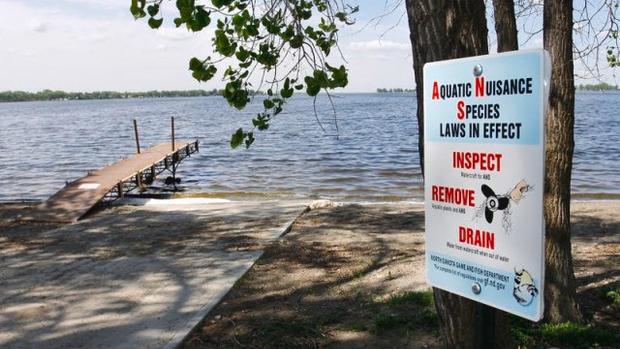
While many of North Dakota’s ANS prevention regulations are similar to surrounding states and provinces, State Game and Fish Department ANS coordinator Jessica Howell says there are some subtle differences that could lead to travel interruption or citations depending on the circumstances.

“Removal of all water and vegetation, as well as pulled plugs while traveling, are generally the rule in neighboring states and provinces,” Howell said, “but there are some places where ‘dry’ is also a requirement, meaning no residual water anywhere in the boat.”

In addition, mandatory boat inspections may be required based on destination or route taken. For example, Howell said anyone pulling a boat into Canada will likely have it inspected at a border crossing, some states have inspection checkpoints along highways, and some lakes have inspectors at boat ramps. Any boats that are not in compliance will likely get delayed in their travels or be prevented from launching, Howell added.

Boaters should be aware of regulations for not only their destination, but for any states they are traveling through. More information on bordering state and provincial ANS regulations is available at the following web addresses.

· South Dakota Fish and Parks at sdleastwanted.com

· Minnesota Department of Natural Resources at fwp.mt.gov/fishing/guide/ ethics

· Saskatchewan Ministry of Environment http:// environment.gov.sk.ca

· Manitoba Department of Sustainable Development, http://www.gov. mb.ca/conservation/ waterstewardship/stopais/ index.html

North Dakota ANS regulations are as follows:

· All aquatic vegetation must be removed from boats, personal watercraft, trailers and fishing equipment such as fishing poles, bait buckets, lures and waders before leaving a body of water. That means “vegetation free” when transporting watercraft and/or equipment away from a boat ramp, landing area or shoreline. Time out of the water needed to remove aquatic vegetation at the immediate water access area is allowed.

· All water must be drained from boats and other watercraft, including bilges, livewells, baitwells and motors before leaving a water body.

· All drain plugs that may hold back water must be removed, and water draining devices must be open, on all watercraft and recreational, commercial and construction equipment bilges and confined spaces, during any out-of-water transport of same.

· Transportation of fish in or on ice is allowed.

· Live aquatic bait or aquatic vegetation may not be transported into North Dakota.

· All legal live aquatic organisms used by anglers, including legal baitfish (fathead minnows), amphibians (salamanders and frogs), invertebrates (crayfish and leeches) and insects must be purchased and/or trapped in North Dakota.

· Anglers may not transport live bait in water away from the Red River (Class I ANS infested waters). All water must be drained from bait buckets as anglers leave the shore, or remove their boat from the water. Anglers must properly dispose of unused bait away from the river, as dumping bait in the water or on shore is illegal.

· In all other waters not infested with Class I ANS species, anglers can transport live bait in water in containers of five gallons or less in volume.

Game Warden Exam Set for Aug. 5

Displaying DSCN2302.jpgDisplaying DSCN2302.jpg

enforcement

The North Dakota Game and Fish Department has scheduled an examination to select candidates for the position of district game warden. The test is at 10 a.m.,Aug. 5, at the department’s main office in Bismarck.

Applicants must register to take the exam no later than Aug. 1 by submitting anonline application through the North Dakota State Job Openings website.

Applicants must be at least 21 years of age and have a bachelor’s degree at time of hire (tentative hire date is Oct. 1), have a valid driver’s license and a current North Dakota peace officer license, or be eligible to be licensed. Candidates must have excellent interpersonal skills in communications and writing, and must not have a record of any felony convictions.

District game wardens enforce game and fish laws and related regulations in an assigned district and other locations as determined by the department. Wardens normally work alone under varied conditions, at all hours of the day, night and weekends. In addition to law enforcement duties, wardens assist in the areas of public relations, education programs, and hunter and boat safety education.

Salary through training for a district game warden is $3,800 per month. Upon successful completion of training, the monthly salary ranges are $4,260 – $7,100. Wardens also receive the state benefits package, including travel allowance. Uniforms and other equipment are provided.

Have You Read? June North Dakota Outdoors magazine

The 2016 June issue of North Dakota Outdoors magazine is available FREE online right now here.

Amy McCann  celebrates the anniversary of an important component of the outdoors across the nation and in North Dakota  with 2016 National Park Service Centennial. The National Park System now includes 411 areas throughout the United States, including several areas in North Dakota that embrace the scenic, historic and wildlife values the park system is designed to preserve. The NPS is celebrating its centennial by connecting with the next generation of conservation stewards.

Ron Wilson takes you inside Young Minds Outdoors: The Envirothon is a problem-solving natural resource competition for high school students. On day one, teams walking designated outdoor trails with specific stops, are tested on their knowledge of soils, wildlife, aquatics and prairie. The competition ends with oral presentations.

Did you know the Game and Fish fisheries development program provides grants to fund up to 75 percent of local projects that develop fishing or boating opportunities?

Local entities are then required to provide the remaining 25 percent of the cost, maintain the project and carry liability insurance. Local partners range from park boards to wildlife clubs. Luann Dart show’s how these partnerships are working for anglers across the state in Anglers Benefit From Agency Partnerships.

Check these stories and more for free in the full June issue available right here or here http://gf.nd.gov/publications.

Spring Breeding Duck Numbers Tallied


The North Dakota Game and Fish Department’s annual spring breeding duck survey conducted in May showed an index of 3.4 million birds, down 5 percent from last year.

photo by Ed Bry, ND Game and Fish

“The spring migration was well ahead of normal as open fields and warm temperatures allowed early migrants to pass quickly through the state,” said migratory game bird supervisor Mike Szymanski.

Survey results indicated all species, except ruddy ducks (up 19 percent) and gadwall (up 4 percent), decreased from their 2015 estimates, while shovelers remained unchanged. Mallards were down 9 percent, pintails down 17 percent and canvasbacks down 18 percent. However all species, with the exception of pintails and canvasbacks, were above the long-term average (1948-2015).

Szymanski said the number of temporary and seasonal wetlands was substantially lower than last year, with the spring water index down 50 percent.

“However, conditions coming out of May into June were much wetter than what we observed during the week of the survey,” Szymanski added. “Frequent rains have since filled many wetlands that are beneficial for breeding ducks.”

The water index is based on basins with water, and does not necessarily represent the amount of water contained in wetlands or the type of wetlands represented.

Szymanski said the July brood survey will provide a better idea of duck production and insight into expectations for this fall. “The total breeding duck index is still in the top 20 all time, so there is still a lot of potential for good production this year,” he added. “Hopefully improved wetland conditions since the May survey will carry through into increased wetland availability for duck broods.”

Have You Seen? Baby Wildlife!


This week’s North Dakota Outdoors video features North Dakota Game and Fish biologist Pat Isackson. Many animals across the state are raising young this time of year.

photo by Harold Umber, ND Game and Fish What should you do and not do when you come across wild baby animals? The video is here or ://gf.nd.gov/publications/television/outdoors-online-webcast.

Learn more about wildlife of North Dakota by clicking right here http://gf.nd.gov/wildlife

Handle Fish With Care

North Dakota’s open water fishing season has many anglers hoping to land that elusive trophy fish. While hooking a wall-mounter is important for some anglers, others simply enjoy the thrill and return the fish back into the water.

white bass horizontal release close up


Catch-and-release is effective only if released fish are handled carefully. The following precautions will enhance the likelihood of a released fish remaining healthy:


·         Fish should be caught from depths less than 30 feet.


·         Land the fish quickly. If possible, don’t play the fish to exhaustion while attempting to bring it in.


·         A needle-nose pliers or similar tool should be used to remove the hook.


·         When removing the hook, don’t squeeze the fish or hold it by its eye sockets, and avoid contact with the gills.


·         If the fish is hooked deep, cut the line close to the mouth.


·         If possible, hold the fish in the water while preparing it for release, including while handling it to remove the hook.


·         Don’t throw the fish into the water. When releasing it, place it into the water and move it slowly back and forth until it becomes acclimated.